

Choosing Orthopaedics: Dr. Ezekiel Oburu’s Story
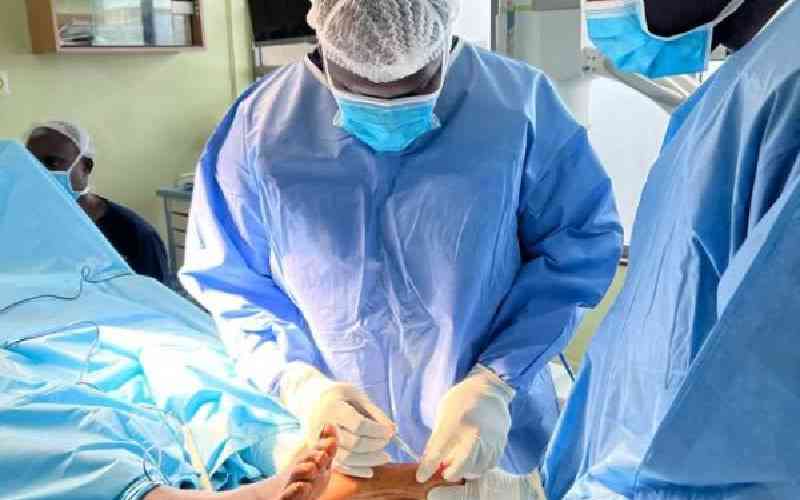
Not every doctor arrives at their specialty in a straight line. For Dr. Oburu, the path to orthopaedic surgery wound through an early dream of nephrology, four years of general surgery training, a fellowship abroad, and an honest reckoning with why he was really making the choices he was making. What emerged, over decades of practice, is a surgeon who not only loves his work — but has devoted much of his career to making sure others can find and access it too.
The beginning
“To be honest,” he says, pausing as though summoning courage for the admission, “I wanted to become a kidney physician initially.” The pull toward nephrology was real — but it gave way, gradually, to something else. A curiosity about surgery. A desire to work with his hands. And, he concedes with disarming candour, the allure of a better income.
Orthopaedics was not readily accessible in Kenya at that time. No medical school in the country offered a direct route into the specialty — the prescribed path ran through general surgery first. He completed his undergraduate training in 1998, finished his general surgical training in 2004, then pursued subspecialty orthopaedic training through to 2011. A further eight months in Australia followed in 2012. “I would say I was really practising from 2005,” he reflects. “And even before I went to specialise, I was doing it as a general surgeon — but we never really practised as well.”
One should not necessarily do something because of money. You can make money also — but money is not everything.”
It was only much later, he says, that the deeper truth settled in: the reasons he had given himself for choosing surgery were not the right ones. “That I discovered much later. Go for your passion and what you love.”
Advice for the next generation
When asked what he would tell a medical student uncertain about which path to take, Dr. Oburu’s answer is practical before it is philosophical. “Try and find out what a specialty entails,” he says. “Many times, people don’t know what these specialties actually involve. You don’t know what a kidney doctor or a rheumatologist really does day to day — especially at the subspecialty level.”
His prescription is simple: go and see for yourself. Spend time in public hospitals. Shadow consultants. Attend ward rounds and theatre lists. “Attach yourself to a clinician in a public hospital. Go out there, spend a week with them. Try and see what they’re doing.” It is grounded, experience-tested advice — exactly the kind that can save a young doctor years of uncertainty.
He is also candid about the breadth of the field. Contrary to the common assumption that orthopaedic surgery means endless hours in theatre, the reality is far more varied. Yes, some complex procedures — spine surgery, pelvic reconstruction — can run six or seven hours. But many operations take only ten to fifteen minutes. “It is so wide,” he says. “Some operations take ten, fifteen minutes. Some take six, seven hours. It really depends.” For his own subspecialty work in foot and ankle surgery, the most complex cases run two to four hours at most. The field, in other words, has room for surgeons of all temperaments — provided they find the corner of it that suits them.
Building something new
Within orthopaedics, Dr. Oburu’s heart lies in particular corners of the specialty. “My favourite areas are foot and ankle surgery, and shoulder and elbow surgery. I really love those.” But loving them, he found, was not enough — he also had to fight for their recognition.
When he first wanted to subspecialise in foot and ankle surgery, the field was barely known in Kenya. Rather than be deterred, he took it as a challenge — introducing the subspecialty, creating awareness, and gradually building a practice around it. He has done the same with arthroscopy, a minimally invasive surgical technique that until recently very few practitioners in the country were performing. “Many people were really mystified about it,” he says, “but now it is more mainstream.” There is quiet pride in the way he describes this — not the pride of personal achievement, but of having opened a door that was previously closed to patients who needed it.
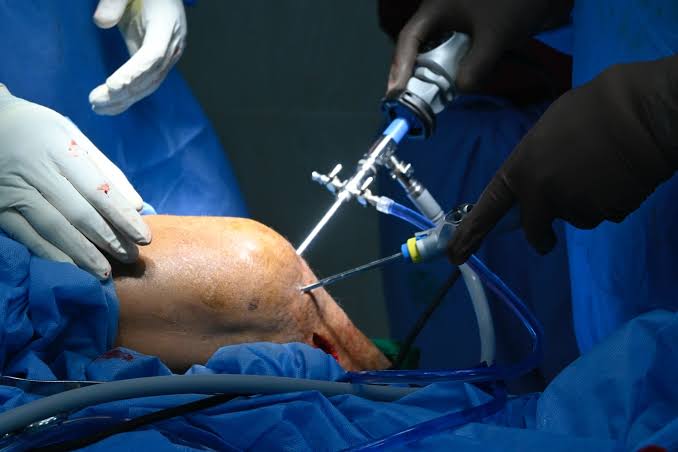
Image: Arthroscopic knee surgery, a minimally invasive procedure used to diagnose and treat joint problems.
The challenges
Dr. Oburu is candid about the difficulties that come with practising orthopaedic surgery in a resource-limited setting. The most immediate is infrastructure. “The public hospital is not well equipped,” he says. “Sometimes you would like to do things there, but you just can’t. You cannot work as efficiently.” It is a frustration familiar to many surgeons across the continent — the gap between what is possible and what the system can support.
But there is another challenge he identifies, more personal in nature: the culture around complications. “When I started working in this country, I remember around 2013 — when you had a complication, people were alone with it. There was no real sharing.” That, he says, has changed. Surgeons are more willing now to discuss difficulties openly, to seek peer support, to learn from one another’s hard cases. It is a shift he welcomes. “People are now more willing to share about what difficulties they may be having.”
The proudest moments
Ask Dr. Oburu about his proudest achievement and he does not point to a landmark surgery or an academic publication. He points to a period in his career when he worked exclusively in the public sector.
“There was a time in my life when all my practice was in the public hospital,” he says. “I think that’s probably the most fulfilling time of my life — because I was just trying to help patients who could not afford.” The responsibilities of a career eventually drew him toward private practice as well, but the memory of that time stays with him. “Just helping people while I’m able to. It’s a blessing beyond blessing, really.”
Stress, burnout, and the weight of complications
For medical students anxious about the emotional demands of surgery, Dr. Oburu offers neither false reassurance nor alarm. He is simply honest. “Not everything goes like a carpet,” he says. “Some things do not go as planned. Never. Not everything goes fine.”
His framework for navigating this is built on three pillars. First, honesty with patients — setting realistic expectations before an operation, being transparent about risks, and having the difficult conversation when things do not go as planned. “You need to be thoroughly honest with patients. If something does not go the way you wanted it to go, you need to tell them.” Second, sharing with colleagues. No surgeon should carry complications alone. Peer discussion, he believes, is both professionally valuable and personally essential. Third — and perhaps most importantly — a life outside medicine. “You need to have a life outside. Go and fill it.”
“You need to have a life outside. Go and fill it.”
For Dr. Oburu, that life outside looks like long walks and time with his children. He trained in Scotland — a country he associates, with a smile, with golf — but has never taken up the game. Football, too, he follows only from a deliberate distance. He supports Arsenal, but avoids the emotional investment of watching matches closely. “I don’t want to get too tied up with my team,” he laughs. As it happens, his restraint has been rewarded: Arsenal ended a 22-year wait to be crowned Premier League champions in the 2025–26 season — a triumph he can savour entirely without the stress of having watched it unfold.
A final word
When asked what advice he would give medical students about navigating stress, Dr. Oburu’s answer carries the weight of personal reflection. “One mistake I made in medical school is I thought that medical school was everything,” he says. “I was really surprised — five years later, on the job, I discovered there had been a hockey team at my medical school the whole time. I had no idea.”
The lesson is simple, and he delivers it with warmth: medicine is an important part of your life, but it is only a part. Do not let it become the whole. Nurture your relationships, pursue your interests, protect your rest. The patients will need you — but they will need you whole.
“Medicine is an aspect of your life,” he says. “That’s all.”
— Interview conducted at Nairobi Spine and Orthopaedic Centre by Manu Wandera.

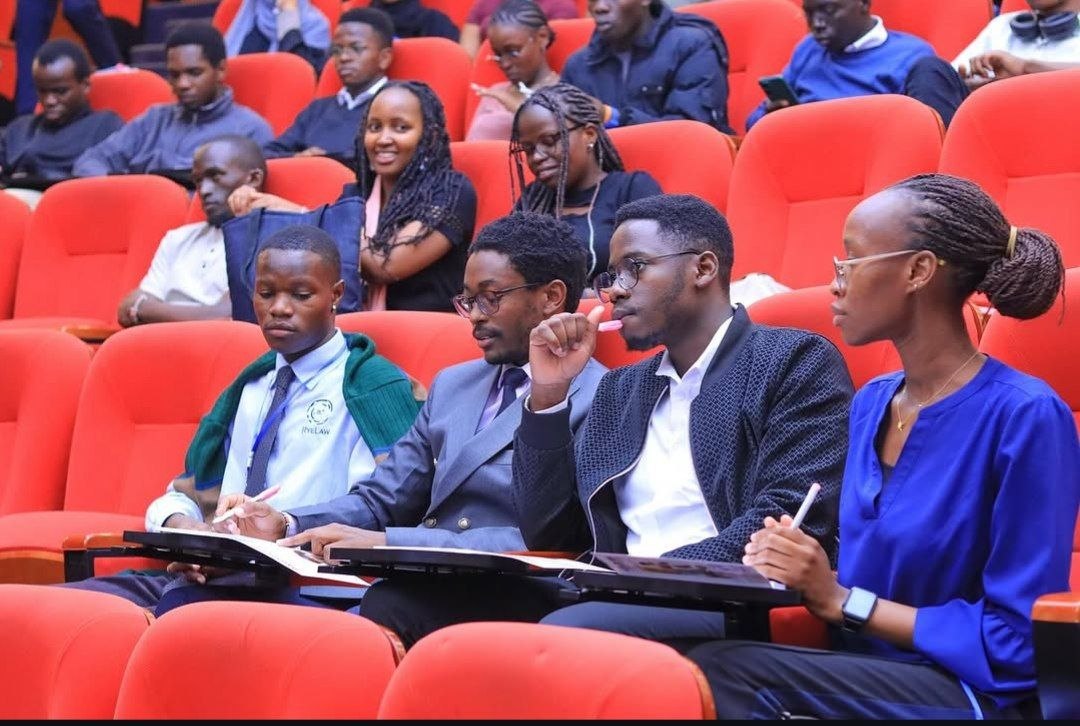
Thank you mTV and Dr Oburu for shedding light on life of a great surgeon like Dr Oburu.