

Is Gen Z Becoming Less Intelligent? The Debate Behind the Decline in Cognitive Scores
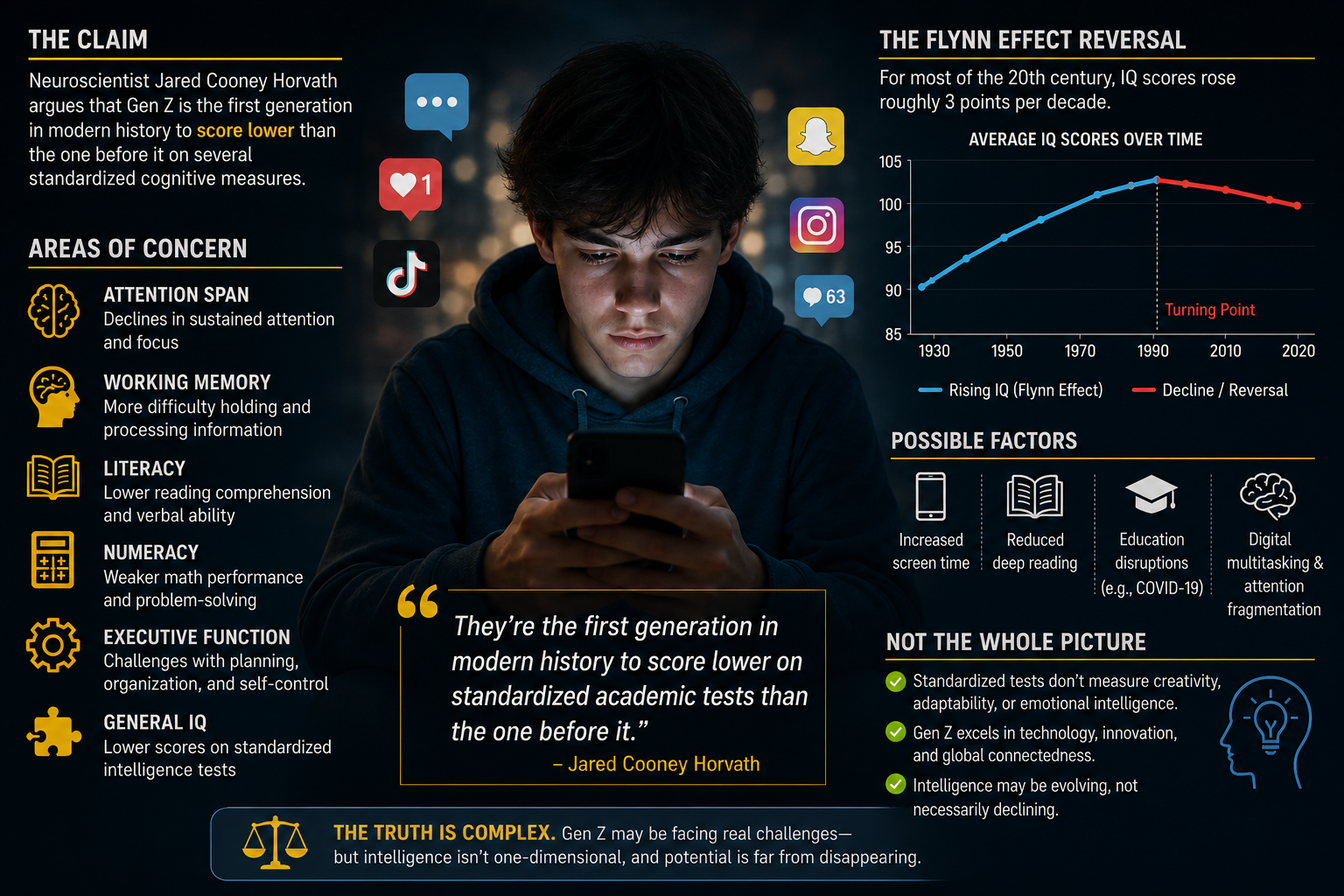
For decades, scientists believed that each generation was becoming smarter than the last. Average IQ scores steadily increased throughout the 20th century in what became known as the “Flynn Effect.” Better nutrition, improved education, healthcare and access to information were thought to be pushing human cognitive performance upward.
But recent discussions in neuroscience and education are challenging that assumption.
Neuroscientist Jared Cooney Horvath recently sparked debate after arguing that Generation Z may be the first modern generation to perform worse than its predecessors on several standardized cognitive measures. According to Horvath, younger people are showing declines in areas such as attention span, literacy, memory, numeracy and problem-solving.
His claims quickly spread online, igniting arguments across classrooms, workplaces and social media. Some people agreed immediately, pointing to shrinking reading habits and growing dependence on short-form digital content. Others pushed back, arguing that intelligence cannot simply be measured by test scores designed decades ago.
At the center of the debate is a changing world. Gen Z grew up in an era dominated by smartphones, social media, instant information and constant digital stimulation. Unlike previous generations, many members of Gen Z have never experienced a world without the internet.
Critics argue that this environment may be affecting deep focus and long-term memory. Endless scrolling, rapid multitasking and short-form videos may train the brain to consume information quickly without processing it deeply. Teachers across different countries have also reported increased difficulties with concentration, reading comprehension and sustained academic engagement among students.
The COVID-19 pandemic may have worsened the situation. School closures and online learning disrupted education globally, leaving noticeable gaps in literacy and mathematics performance for many students.
However, many experts caution against labeling Gen Z as “less intelligent.” Intelligence itself is complex and constantly evolving. While younger generations may struggle more with traditional academic testing, they often excel in digital navigation, technological adaptability, online communication and rapid information processing.
Some researchers believe society may simply be witnessing a shift in the type of intelligence that is valued. Traditional measures reward memorization, prolonged concentration and structured reasoning. Modern life increasingly rewards speed, adaptability, creativity, and technological fluency.
There is also the question of whether standardized tests still reflect real-world intelligence in the digital age. A generation capable of building online businesses, learning skills independently through the internet and navigating advanced technology may demonstrate intelligence differently from previous generations.
Ultimately, the debate is far from settled.
What is clear, however, is that the conversation extends beyond IQ scores. It touches on education systems, technology, social media, mental health and how modern environments shape the human brain.
Whether Gen Z is truly becoming less intelligent – or simply intelligent in different ways – remains one of the most important questions facing educators and scientists today.