

Christopher Columbus and the Journey of Trypanosoma cruzi
Christopher Columbus never knew he was carrying history in more ways than one.
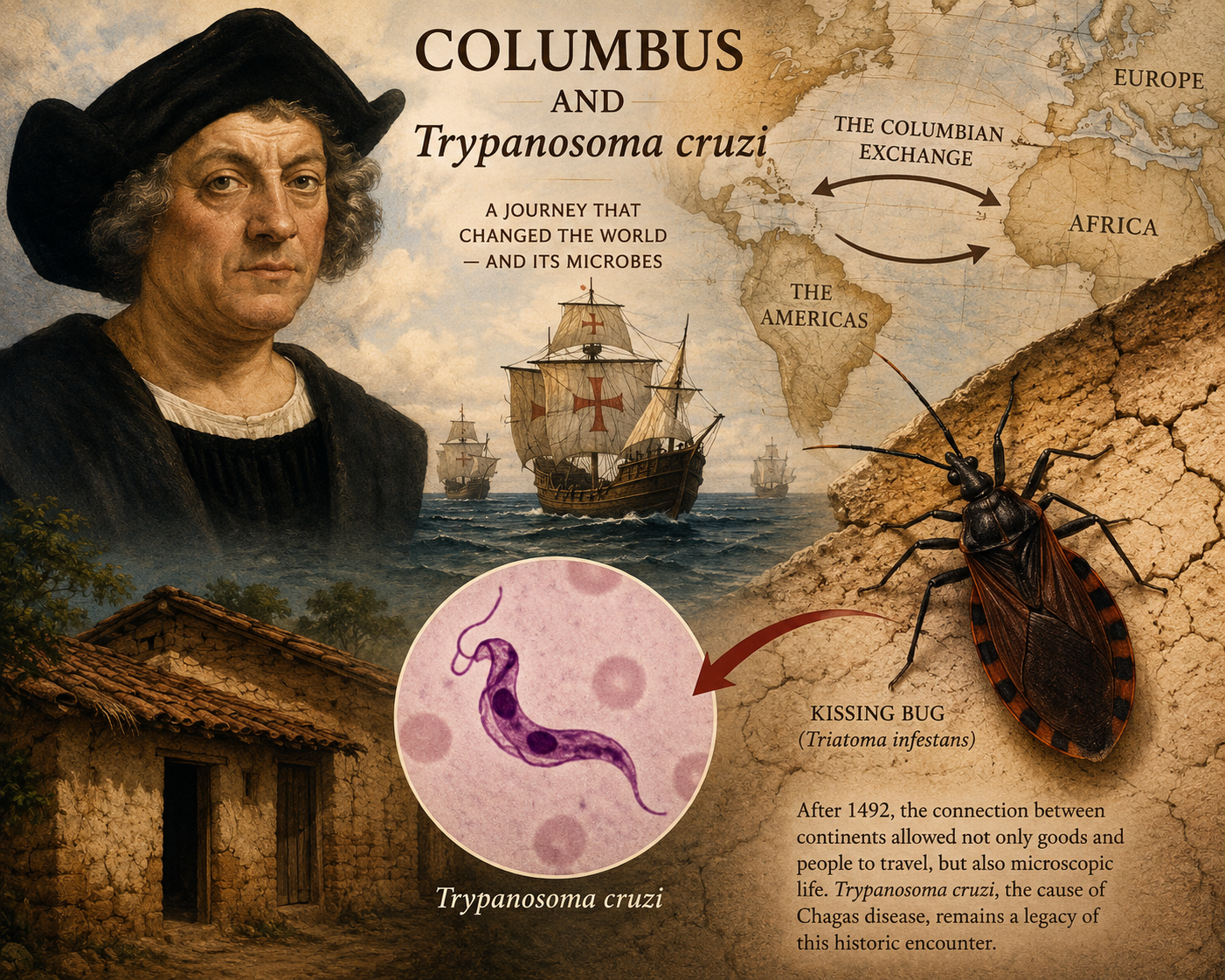
In 1492, when Christopher Columbus sailed across the Atlantic, Europe celebrated the “discovery” of the New World. Ships docked, flags were raised, and kingdoms dreamed of gold. But hidden in the shadows of the Americas was another traveler waiting to begin its own journey, Chagas disease, caused by the parasite Trypanosoma cruzi.
Long before Europeans arrived, the parasite quietly circulated among wild animals in Latin America. It lived inside armadillos, opossums and other mammals, passed from host to host by the bite of the “kissing bug,” a blood-sucking insect that attacked sleeping people at night. The parasite had existed for centuries, unnoticed by the outside world.
Then came Columbus.
His voyages opened permanent contact between Europe and the Americas in what historians call the Columbian Exchange – a massive transfer of plants, animals, people, diseases and cultures between continents. Europe sent horses, cattle and smallpox westward. The Americas sent maize, potatoes and tobacco eastward. Hidden among these exchanges were microorganisms and parasites, including species of Trypanosoma.
For centuries, nobody understood what caused the strange illness seen in rural South America: swollen eyes, heart failure, enlarged intestines, sudden death in young adults. People blamed curses, spirits or bad air. The tiny parasite remained invisible.
Then, in 1909, Brazilian physician Carlos Chagas made a discovery that stunned the scientific world. While working in poor villages, he identified the insect vector, discovered the parasite, described the disease and linked all of them together – one of the few times in medical history a single scientist uncovered an entire disease system alone.
Under the microscope, the parasite looked almost elegant: a slender organism with a whip-like flagellum twisting through blood like a microscopic serpent. It belonged to the genus Trypanosoma, relatives of the parasites that cause African sleeping sickness.
Today, the story continues far beyond the Americas. Migration and globalization have carried Chagas disease across continents. Cases are now found in North America, Europe and other regions – a reminder that Columbus did not just connect worlds politically and economically. He connected them biologically too.
History remembers Columbus for ships and maps.
Medicine remembers that his voyages also changed the geography of disease forever.